


Trump Escalates Military Threats in Hormuz
as Iran Prepares for New Round of
US-Israeli Bombings and Assassinations
Jeremy Scahill / Drop Site News
(May 4, 2026) — President Donald Trump is scrambling to find a way to declare victory in the war against Iran—vacillating between public demands to make a deal and threats to unleash a new round of massive bombing. The U.S. naval blockade on the Strait of Hormuz has sparked a global economic and energy crisis, and neither the blockade nor Trump’s threats have resulted in Iranian capitulation or a willingness to forfeit any of its rights to control maritime traffic in the Strait.
A senior Iranian official told Drop Site that while Iran is actively engaged in indirect diplomacy with the U.S. via mediators, it has no intention of participating in direct talks until the U.S. blockade is unconditionally lifted.
“Based on current assessments, another military attack seems likely. [Trump’s] goals from the naval blockade haven’t been achieved,” the official said. “He can’t keep the blockade going for much longer. We think the U.S. will focus on Hormuz, so military attacks and operations will likely expand along Iran’s coastline, along with a new wave of assassinations [against Iranian leaders] they may pursue jointly with Israel.”
The official, who requested anonymity because he is not authorized to publicly comment, has direct knowledge of internal deliberations in Tehran. Trump, he argued, has limited options to find an off-ramp from his increasingly unpopular war.
“We have succeeded, through the sustained management of the Strait of Hormuz under our control, in effectively transforming the unilateral pressure imposed by the Americans into a reciprocal one. As time progresses, the restrictions imposed on this strategic chokepoint will generate increasingly widespread consequences for various goods and commodities worldwide,” he said. “The United States has, in practice, positioned itself as a destabilizing force for the global economy particularly in the energy sector. This development, from a strategic perspective, works clearly and substantially to Iran’s advantage.”
On Sunday afternoon, Trump announced that the U.S. would begin to “guide” merchant vessels stuck in the Strait out of Iranian waters. “If, in any way, this Humanitarian process is interfered with, that interference will, unfortunately, have to be dealt with forcefully,” Trump wrote on Truth Social. U.S. Central Command announced that it would support what Trump called “Project Freedom” with “guided-missile destroyers, over 100 land and sea-based aircraft, multi-domain unmanned platforms, and 15,000 service members.”
Trump posted his announcement shortly before oil futures trading opened, sparking speculation it was—at least in part—an attempt to manipulate markets. After Trump’s post, U.S. officials told numerous news outlets that the military was not planning to enter Iranian waters, but would respond to attacks on ships that attempted to leave the Strait.
Trump’s action “is primarily intended to provoke Iran into taking an initial step toward confrontation, thereby creating a pretext for escalation and enabling him to justify further military action in response to an Iranian initiative,” said the Iranian official. Any attempt to alter “current conditions” in the Strait, he warned, would spark a forceful response. “Any commercial vessel attempting to transit through designated restricted routes without prior coordination will be promptly intercepted by Iranian forces. Should U.S. military vessels respond, such actions would be met with an immediate and corresponding response from Iran,” the official asserted. “Trump has effectively turned [civilian merchant vessels] into bargaining tools in his political game.”
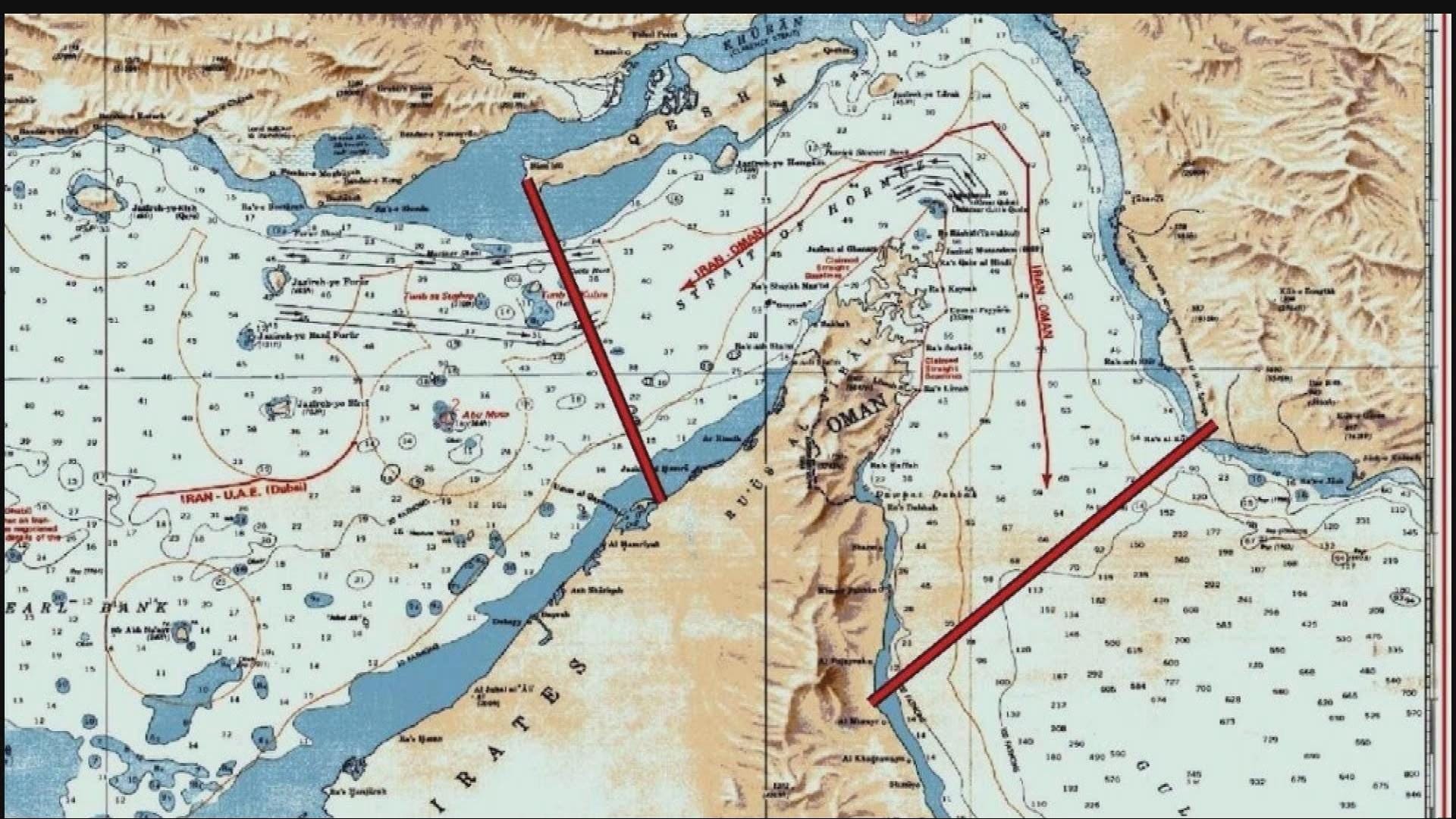
A map published by Iran’s Islamic Revolutionary Guard Corps Navy depicting areas in the Strait of Hormuz under its control. Source: Fars News.
Iran’s Two Track Planning
Over the past few weeks, Iranian political and military leaders have declared strategic victory over the U.S., promoting their view that Trump is submerged in a quagmire of his own making. “Trump must choose between an impossible military operation or a bad deal with the Islamic Republic of Iran,” the IRGC’s intelligence division declared in a statement posted on Sunday on X. “The room for U.S. decision-making has narrowed.”
Kuwait did not export any crude oil during the entire month of April, the first time this has happened since the 1991 Gulf War and panic is spreading across Arab countries in the Gulf over the fate of their oil and gas revenue and the instability of the future. Trump is scheduled to visit China on May 14. Beijing is the most powerful nation with a significant stake in what happens in the Strait of Hormuz and has steadily asserted its demands that a resolution be reached. On May 2, the Chinese government announced that it was blocking compliance with U.S. sanctions on domestic refineries that import Iranian oil, including Hengli refinery, one of the country’s largest petrochemical complexes.
In a statement about the decision, China’s commerce ministry said it had issued the “prohibition order” preventing enforcement of the sanctions in order to “safeguard national sovereignty, security, and development interests.”
“The only thing that reaches [Trump] is how bad the economy is going and how much that is going to create a problem for him and how much of a problem it’s going to be for him if he has to show up in Beijing and face the Chinese from this utter position of embarrassment and weakness,” said Parsi. “He still has this false illusion that the blockade, one way or another, is going to deliver him the type of a victory that will rewrite the entire history of these last seven, eight weeks. If he goes after Iran’s exports to China, he will not only escalate this regional conflict into a global conflict, but he will further push up oil prices, which will backfire faster on him than it will backfire on the Iranians.”
The Iranian official told Drop Site that as a result of Trump’s erratic posture and out of economic necessity created by the blockade in the Strait of Hormuz, Tehran is operating on two tracks: engaging in indirect diplomatic negotiations aimed at achieving a mutually agreed framework for direct talks on ending the war; and preparing for a scenario where no deal is reached, the crisis in the Strait continues, and Iran faces an ongoing spectre of U.S. or Israeli attacks.
“If we can manage the impact of the maritime blockade in the coming weeks, serious tensions between China and the U.S. are likely to begin, which would shift the dynamics and nature of the negotiations,” the Iranian official said. Tehran, he said, is “focused on strategic issues such as accelerating cooperation among Eastern countries to neutralize American pressure and leverage.”
Throughout the war, Iran has intensified its diplomatic efforts to strengthen ties and partnerships with a range of countries. Araghchi’s recent face-to-face meeting with Russian President Vladimir Putin came as the Iranian foreign minister publicly snubbed U.S. officials after Trump claimed a new round of talks with Vice President JD Vance was imminent. Iran has also maintained close contact with China and has coordinated with Beijing in moving shipments through the Strait of Hormuz during the U.S. blockade.
Tehran has been developing a new framework for administering the Strait, reportedly including a ban on Israeli ships and a toll-based system for safe passage. Iran’s new Supreme Leader Mojtaba Khamenei said in a statement read on state TV on April 30 that Iran “will ensure security in the Persian Gulf region and put an end to the abuse of this strategic waterway by hostile forces.” He added, “Those who come from afar with greedy and hostile intentions have no place in this region—except at the bottom of its waters.”
While the U.S. and Europe have denounced Iran’s plans, Tehran has been focused on winning support for a new mechanism from its strategic allies.
Parsi said that while some countries may balk at the idea of paying tolls to Iran, eventually they would accept it as a new norm. “At the end of the day, they need their oil and they will pay the fees. And the Iranians are going to use the fee collections, not necessarily as something that replaces all income, but something that forces countries to reestablish financial connections with Iran, countries that otherwise had left the Iranian market as a result of US sanctions,” he said. “Now the Iranians have leverage to push them back in. And that is of tremendous value to them to be able to make sure that they have these connections.”
Iranian officials have spent weeks briefing regional allies on Tehran’s proposals for the Strait, but also understand that getting Moscow and Beijing onboard is crucial.
“Neither China nor Russia has expressed any official opposition at the formal level,” the senior Iranian official said. “Since there is no established international precedent, any payment would need to be defined in exchange for services. These advisory considerations have already been taken into account in Iran’s draft plan, which is currently being finalized.”
On Monday, the IRGC published a map outlining what it called a new “area of control” in the Strait, featuring two red lines cutting from Iran’s southern coast to ports in the United Arab Emirates. An IRGC official said it was not a change in policy, but a clarification of the areas where vessels would need to follow Iranian protocols for safe passage.
The future of all of these plans depends on how the broader war plays out in the days and weeks ahead. The U.S. could attempt to re-open the Strait by force, an operation that would bring extreme risks for Trump on both a tactical and political level and would be extremely difficult, if not impossible, to sustain without a complete change of government in Tehran. It is possible the U.S. and Iran could reach an agreement through negotiations, but this would almost certainly result in Iran retaining its dominance of transit. Trump has, at times, suggested he may leave the fate of the Strait to other countries to resolve, claiming the U.S. does not need it.
“If this new scenario ends up becoming contested, in which the risk of war is still there, looming in the background, in which there isn’t full acceptance and as a result you also don’t have a full flow of oil, that will ensure that the international markets are going to try to reduce the strategic significance of the Strait of Hormuz,” Parsi said. “In that scenario, Iran needs to also have an alternative.”
As it works on its future plans for managing Hormuz, Iran also has been working to prepare for such a scenario. It has been negotiating the expansion of alternative land shipping options in the region and is brokering the erection of a network of routes transiting Pakistan and Afghanistan, a parallel trade system outside of Western dominance. Iran envisions this as establishing itself as a central transit hub in the heart of central and western Asia.
“This is an important development. For years, we did not pay much attention to developing land transit infrastructure due to a lack of necessity. However, we are now moving forward at a very fast pace, and the level of engagement from the countries involved in these corridors has genuinely surprised us,” said the Iranian official. “This dynamic is reshaping the region and will significantly transform the future of trade and the nature of relations between countries in West Asia.”
These alternative land routes are not just long-term strategic planning by Tehran, but a direct response to the blockade in the Strait of Hormuz that Iran believes will allow it to endure a prolonged standoff by countering some of the economic and supply impact. “Our volume of maritime trade is very high, so naturally shifting it to land transit won’t be easy,” the official said. But, he added, “things are actually moving forward at a really good pace.”
