


Trump Finds Out! Washington
Is the War Capital of the World
David Stockman / Antiwar.com
Part 2
Sometimes an especially stubborn mule needs to have a 2X4 administered squarely between the eyes. Repeatedly.
The same can be said about the politicians, commentators, think tanks and lobbyists for the merchants of war who practice their malefic arts amidst the fog of propaganda, lies, venality and humbug which literally suffuses the air – indoors and outdoors alike – over the War Capital of the World on the Potomac.
So here’s today’s 2X4. There is no justification whatsoever for the proxy war on Russia now being conducted with US dollars and weapons on the killing fields of Ukraine. As we saw in Part 1, a Russian nuclear attack against the US is so utterly implausible that even a semi-educated mule would understand: No Kremlin leader is ever going to light a match that would bring down 13,000 Hiroshima’s on the Russian Motherland and kill or injure 90 million citizens or nearly 65% of its population. Full stop.
As it happens, moreover, the entire US triad nuclear deterrent costs only about $75 billion a year to assure the nuclear peace via MAD, and does not require a single foreign base, alliance or sign-off from anyone outside of Washington DC. So virtually all of the rest of the nation’s $1 trillion DOD budget and $1.5 trillion Warfare State overall amounts to a self-licking ice cream cone.
That is to say, the massive $1.5 trillion annual Warfare State assault on US taxpayers essentially fuels its own perpetuation via endless inflation of foreign threats, continuous provocation of alleged foreign foes and busy-body interventionist machinations from one end of the planet to the other. The Empire, in effect spends hundreds of billions of the American taxpayers’ dollars each and every year to keep their own elected politicians in thrall to the lies and propaganda which stand at the heart of the Washington domiciled national security apparatus.
Self-perpetuation of the Warfare State, in fact, is the only possible explanation for the idiocy of Washington’s meddling on Russia’s border lands. After all, there is no Russian military threat to the security and liberty of the American Homeland that requires Washington to give a good goddamn about doings over there 5,000 miles from the Potomac River.
Indeed, once you set aside the completely checkmated threat of nuclear attack owing to the shield of MAD, the very idea of a Russian conventional attack and invasion of US territory is so implausible and literally impossible as to belong in the screwball section of the deep outfield bleachers.
For want of doubt, however, we document the implausibility of a Russian conventional attack in detail below. But the spoiler alert is this: Once the 2X4 has awakened the mule to the implausibility of a Russian military threat to the American Homeland – nuclear and conventional alike – the only reason for Empire and war in distant lands like the eastern regions of Ukraine reduces to, ironically, eleemosynary.
Of course, the Warfare State narrative gussies up this planetary gendarme and good shepherd role under the high-minded catchments of “collective security” and the “rule of law”. In the current case, the latter pertains to Moscow’s alleged violation of Ukrainian sovereignty when it invaded in February 2022.
Alas, if there are no military threats to America’s homeland in the world today—and the same stipulation noted above for Russia applies to the alleged menace of Red China, as well – then by definition there is no need for alliances, collective security or enforcement of the so-called “rule of law”. All of these are pretexts for foreign interventions and military adventures, not rudiments of true Homeland Security.
Nevertheless, upholding the rule of law and alleged sovereignty of borders is exactly the canard used to justify Washington’s decades long meddling in Ukraine. The latter, of course, culminated in the February 2014 coup de etat that Washington organized, funded, supported and instantly recognized upon the overthrow of Ukraine’s duly elected president – who happened to be a Russian-speaker and a son of the eastern Russian provinces of Ukraine that would never have provoked war with Moscow.
Even aside from the barking hypocrisy of using the “rule of law” justification for a regime change intervention that Washington foisted upon the hapless population of Ukraine in the first place, the whole narrative is too rich for words.
For crying out loud. Washington has been the regime change champion of the world since 1947, and without peer.
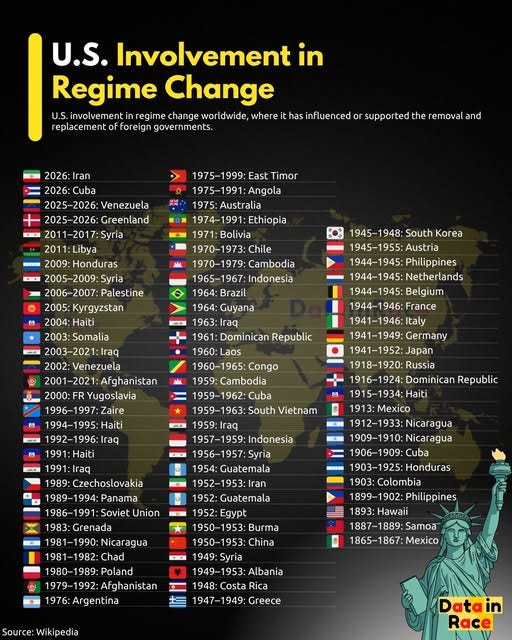
In any event, once the nuclear threat is set aside under the shield of MAD, the notion of a conventional Russian invasion of the United States collapses under the relentless facts of geography and comparative military force structure.
To begin, when it comes to conventional military attack on the homeland territory of the USA, the Atlantic and Pacific oceans are not minor obstacles. To the contrary, they are multi-thousand-mile barriers – the great nature-given moats that has been at the heart of America’s security and safety for 250 years.
Crossing them with an invasionary armada requires the ability to move and protect large numbers of troops, heavy equipment, fuel, munitions, and air cover–including a massive staging capability at home, robust logistical sinews and unfailing re-supply lines circling the earth. Russia possesses almost none of these necessary tools.
The disparity begins with scale. Open assessments place the overall Russian Navy at roughly 1.4 million tonnes of displacement. The U.S. Navy measures nearly six times larger. Its 8.0 milliontonnes of displacement is driven by large carriers, amphibious ships, destroyers, and submarines.
By contrast, Russia’s surface force is a modest collection of aging cruisers, destroyers, and frigates, many of Soviet-era design and dispersed across separated fleets. Its single aircraft carrier, the Admiral Kuznetsov, has not completed an operational deployment since 2016–2017 and remains non-operational after a failed multi-year overhaul. Russia has no other carrier in service.Accordingly, fixed-wing naval aviation is effectively dormant.
Against this stands the U.S. undersea fleet. The Navy operates approximately 50 attack submarines: roughly 20–22 remaining Los Angeles-class boats, three Seawolf-class (Seawolf, Connecticut, and Jimmy Carter), and about 25–26 Virginia-class boats, with more under construction.
These nuclear-powered attack submarines are optimized for anti-surface warfare,intelligence collection, and land attack. A Russian surface group attempting to transit the Strait of Gibraltar or the GIUK gap (Greenland–Iceland–United Kingdom) would enter waters where these submarines, supported by maritime patrol aircraft and allied forces, hold decisive advantages.
Aging Russian destroyers and cruisers, lacking modern layered air defense and continuous organic air cover, would face torpedoes and anti-ship missiles launched from positions they cannot reliably detect or engage. In practical terms, Davy Jones’ Locker waits outside Gibraltar and the GIUK gap for any such Russian formation—the seafloor ready to claim a force that cannot protect itself or sustain its passage.
Even if a Russian surface force somehow survived the transit, it would confront U.S. carrier strike groups organized precisely for control of the open ocean.
Consider the USS Gerald R. Ford (CVN-78), lead ship of its class, as a representative example. The Ford is a nuclear-powered carrier of approximately 100,000 tons with a flight deck of roughly five acres, capable of embarking an air wing of about 70–75 aircraft.
A typical loadout includes multiple squadrons of F/A-18E/F Super Hornets for strike and air superiority, EA-18G Growlers for electronic attack, E-2D Advanced Hawkeyes for airborne early warning and command, and MH-60 helicopters for anti-submarine warfare and other roles. These aircraft deliver precision-guided munitions, anti-radiation missiles, and air-to-air weapons while providing continuous surveillance and electronic warfare.
Moreover, the aircraft carrier obviously does not sail by its lonesome. A Carrier Strike Group built around the Ford typically includes several Arleigh Burke-class guided-missile destroyers (for example, ships such as Bainbridge, Mahan, and Winston S. Churchill in recent deployments). Each destroyer carries up to 96 vertical launch system cells that can be loaded with Tomahawk cruise missiles (ranges exceeding 1,000 miles), Standard Missiles (SM-2/SM-6) for air and missile defense, and other weapons.
The group’s integrated air and missile defense, Aegis combat system, and electronic warfare suite create layered protection against air and missile threats. An attack submarine often operates in company, adding undersea strike and reconnaissance. Logistics ships sustain the formation for months. Collectively, one such group brings sustained carrier aviation, long-range cruise-missile firepower, dense air defense, and extensive electronic and intelligence collection – capabilities that no Russian surface formation could event remotely match or effectively counter.
These asymmetries compound. Without operational carriers, without sufficient aerial tankers (Russia fields only about 15–20 Il-78 refueling aircraft versus the U.S. inventory of roughly 500–600 aerial tankers), and without large-scale amphibious and sealift capacity, Russia just plain cannot generate or protect an invasion force across the ocean.
No sane, or even partially sane, Russian military leaders, therefore, would send an attack armada across the ocean moats toward America. It would be a suicide mission like no other in the annals of naval warfare because Russia’s limited blue-water surface ships would be engaged and attrited long before reaching the approaches to North America.
Russia does have a formidable submarines force which can threaten individual vessels. But self-evidently, you couldn’t move a million man invasionary army accross 5,000 to 10,000 miles of blue water and then sustain and re-supply it via a handful of submarines. Yet that’s what would be needed to seize and hold territory on the North American continent. Indeed, any Russian formation that cleared European waters would still face the same fate: Davy Jones’ Locker lying in wait on the approaches to the American shore.
In short, Russia retains substantial conventional forces optimized for operations near its own borders. Those assets matter in regional contingencies. They do not remotely translate, however, into the ability to project and sustain combat power across open ocean against the United States.
The combination of the two great ocean moats; the overwhelming numbers and lethality of the U.S. attack submarine fleet; the overwhelming carrier strike group firepower (as illustrated by the Ford and its escorts); and the sheer disparity in naval tonnage renders a conventional invasionary operation not just utterly implausible.
It actually means that the very idea of it is a risible joke.
So the question recurs. If the shield of MAD secures the American homeland against nuclear attack and the great ocean moats and US naval capabilities block any route to conventional military invasion, where’s the Russian military threat?
There isn’t one, of course!
What’s left of the whole insane operation since February 2022 – which has cost Uncle Sam $130 billion which he doesn’t have – is thus the biggest Washington lie of all. Namely, that Washington philanthropically came to the aid of the innocent nation of Ukraine, which had suffered an unprovoked invasion by a wanna be world conqueror domiciled in the Kremlin.
Alas, every single bit of that predicate is untrue. As we will amplify in Part 3, it’s just another manufactured “narrative” that is the stock and trade of the insidious forces ensconced within the War Capital of the World on the Potomac.
